
Understanding Full Spectrum LED Lighting for Reptiles
Full spectrum LED lighting plays a vital but often misunderstood role in modern reptile husbandry. While it does not replace UVB or heat, high-quality visible lighting is essential for supporting natural behaviour, activity levels, feeding response, and overall wellbeing in captive reptiles.
In the wild, reptiles experience intense daylight across a broad visible spectrum alongside heat and ultraviolet radiation. In captivity, this daylight component is frequently under-provided, resulting in dim enclosures that fail to stimulate natural behaviour even when temperature and UVB are technically correct.
This guide explains what full spectrum LED lighting is, why it matters, how it differs from UVB and heat sources, and how it fits into a balanced lighting system that prioritises animal welfare and naturalistic enclosure design.
At a Glance
What is Full Spectrum Lighting?
The term full spectrum refers to lighting that closely replicates the visible portion of natural daylight, rather than emitting light in a narrow or colour-biased range.
For reptile enclosures, full spectrum lighting typically means:
- A broad, balanced visible light output
- High brightness levels (lux) compared to standard household bulbs
- Natural colour rendering that accurately reveals enclosure colours
- Consistent, flicker-free illumination across the enclosure
Importantly, full spectrum LEDs do not produce UVB and should never be considered a substitute for ultraviolet lighting. Their role is to provide daylight quality illumination, not biological UV exposure.
Why Visible Light Matters for Reptiles
Reptiles are highly visual animals. In nature, daylight intensity is far higher than most captive setups provide, even when UVB and heat are present.
Adequate visible light supports:
- Normal activity patterns – encouraging movement, exploration, and basking
- Feeding response – many reptiles feed more readily under bright, natural lighting
- Behavioural expression – including basking, hunting, and social signalling
- Circadian rhythm regulation – supporting clear day/night cycles
- Reduced lethargy in species kept under dim conditions
Enclosures that rely solely on heat lamps and UVB tubes often remain visually dull, particularly in shaded areas. Full spectrum LED lighting fills this gap, creating a brighter, more natural environment without increasing heat or UV exposure.
Full Spectrum LEDs vs UVB vs Heat (Clear Roles)
One of the most common mistakes in reptile lighting is expecting one type of lamp to perform multiple functions. Each component has a distinct and non-interchangeable role.
- UVB lighting
Enables vitamin D₃ synthesis and calcium metabolism - Heat sources
Provide thermoregulation and metabolic function - Full spectrum LED lighting
Provides daylight brightness, visual clarity, and behavioural stimulation
Full spectrum LEDs support UVB and heat by improving enclosure illumination, but they cannot replace either. A complete lighting system always considers all three together.
Brightness, Lux, and Enclosure Illumination
Brightness is measured in lux, and this is where many captive setups fall short.
In natural environments, reptiles experience daylight levels far exceeding typical indoor lighting. While enclosures do not need to replicate full sun intensity, they should be significantly brighter than what most heat or UVB lamps alone provide.
Well-designed LED lighting helps to:
- Increase overall enclosure brightness
- Reduce harsh contrast between lit and shaded zones
- Improve visibility in planted or bioactive setups
- Support natural colour perception for the animal
Rather than focusing solely on colour temperature (Kelvin), priority should be given to usable brightness and even coverage.

LEDs In Bioactive and Planted Enclosures
Full spectrum LED lighting is particularly valuable in bioactive and planted setups.
Benefits include:
- Supporting live plant growth
- Enhancing natural enclosure aesthetics
- Improving light penetration into dense planting
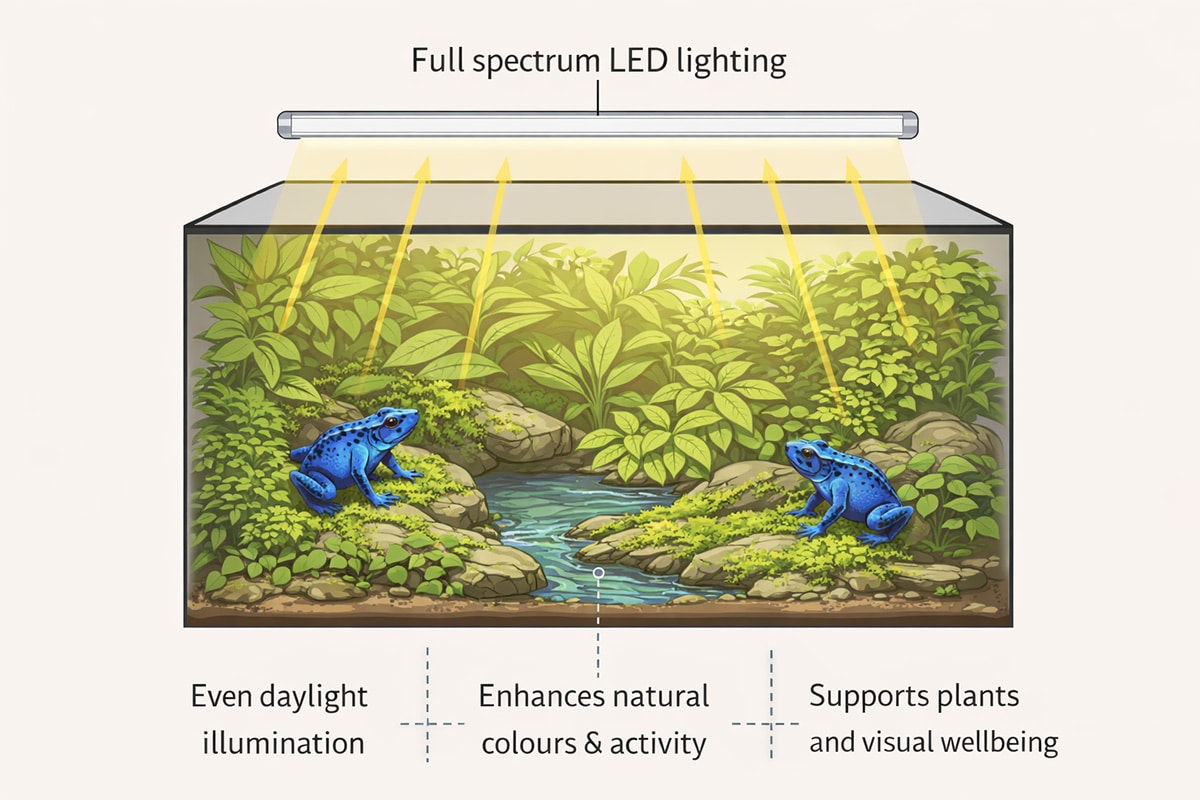
- Creating realistic daylight conditions across the enclosure
Healthy plant growth also contributes indirectly to animal welfare by increasing cover, humidity stability, and environmental complexity.
Placement & Coverage Principles
Unlike UVB, which should be concentrated over the basking zone, full spectrum LED lighting is best used for broad coverage.
General principles:
- LEDs should illuminate a large portion of the enclosure
- Light should overlap but not replace UVB zones
- Shaded retreats must remain available
- LEDs should not create excessive glare or harsh hotspots
Full spectrum lighting works best when integrated into a zoned lighting approach, supporting the Light & Shade Method rather than overriding it.
Common Mistakes with LED Lighting
When used correctly, full spectrum LED lighting is extremely safe.
Best practice includes:
- Using purpose-designed reptile or horticultural LEDs
- Ensuring secure mounting away from direct contact
- Avoiding excessive glare directly into basking positions
- Running LEDs on a consistent day/night cycle
- Integrating LEDs alongside UVB, heat, and enclosure design
As with all lighting components, LEDs should be considered part of a complete system, not an isolated upgrade.
Safety & Best Practice
When used correctly, UVB lighting is safe and highly beneficial. Problems typically arise from incorrect placement, unsuitable equipment, or lack of maintenance rather than from UVB itself.
Best practice guidelines:
- Always provide access to shade and cover so reptiles can regulate their own exposure
- Avoid mounting UVB lamps at distances closer than manufacturer recommendations
- Use appropriate guards or fixtures to prevent direct contact with bulbs
- Ensure UVB lighting does not cover the entire enclosure uniformly
- Replace UVB bulbs at recommended intervals, even if they still appear bright
UVB lighting should be considered as part of a complete system that includes appropriate heat sources, enclosure layout, and dietary supplementation. No single component functions effectively in isolation.
By following established best practices and monitoring your setup regularly, UVB lighting can be provided safely and consistently over the long term.
How Full Spectrum Lighting Fits the Light & Shade Method
The Light & Shade Method relies on giving reptiles choice and control.
Full spectrum LED lighting supports this by:
- Providing bright, natural daylight in exposed zones
- Maintaining dimmer, shaded areas for retreat
- Enhancing the visual gradient that complements thermal and UV gradients
When combined correctly, reptiles can self-regulate exposure to light, heat, and UV independently, closely mirroring natural behaviour.
Further Reading
Why Calcium Is Important For Reptiles → Understand the role of calcium supplementation and the vitamin D₃ cycle in supporting reptile bone health and long-term wellbeing.
Understanding UVB Lighting for Reptiles → A clear explanation of UVB lighting, intensity levels, and how UVB supports reptile health in captivity.
The Light and Shade Method → Learn about the importance of providing reptiles with a correct thermal gradient alongside appropriate UVB and full spectrum lighting.
Choosing The Correct Thermostat → With multiple types of thermostats available, this guide explains the differences and helps you select the most suitable option for controlling reptile environments.
Final Thoughts
Full spectrum LED lighting is not an optional aesthetic upgrade — it is a key component of modern, welfare-focused reptile care.
By improving enclosure brightness, supporting natural behaviour, and complementing UVB and heat systems, LEDs help bridge the gap between captive environments and natural daylight conditions.
When chosen carefully and integrated thoughtfully, full spectrum LED lighting contributes to healthier, more active reptiles and more naturalistic enclosures built around choice, balance, and long-term wellbeing.
For keepers who want to understand the science behind UVB, nutrition and MBD, Arcadia’s reptile books provide the full research background Arcadia Reptile Books →