

Reptile Thermostats: How to Choose the Right Type
Choosing the correct thermostat is a critical part of safe and effective reptile heating. Every heat source behaves differently, and using the wrong type of thermostat can lead to unstable temperatures, equipment failure, or serious risk to the animal.
This guide explains how reptile thermostats work, why different heaters require different control methods, and how to confidently choose the correct HabiStat thermostat for your setup. It is designed to give you a clear, practical understanding — whether you are setting up a new enclosure or reviewing an existing one.
By matching the thermostat to the heat source correctly, you ensure stable temperatures, protect your equipment, and create a safer, more natural environment for your reptile.
At a Glance
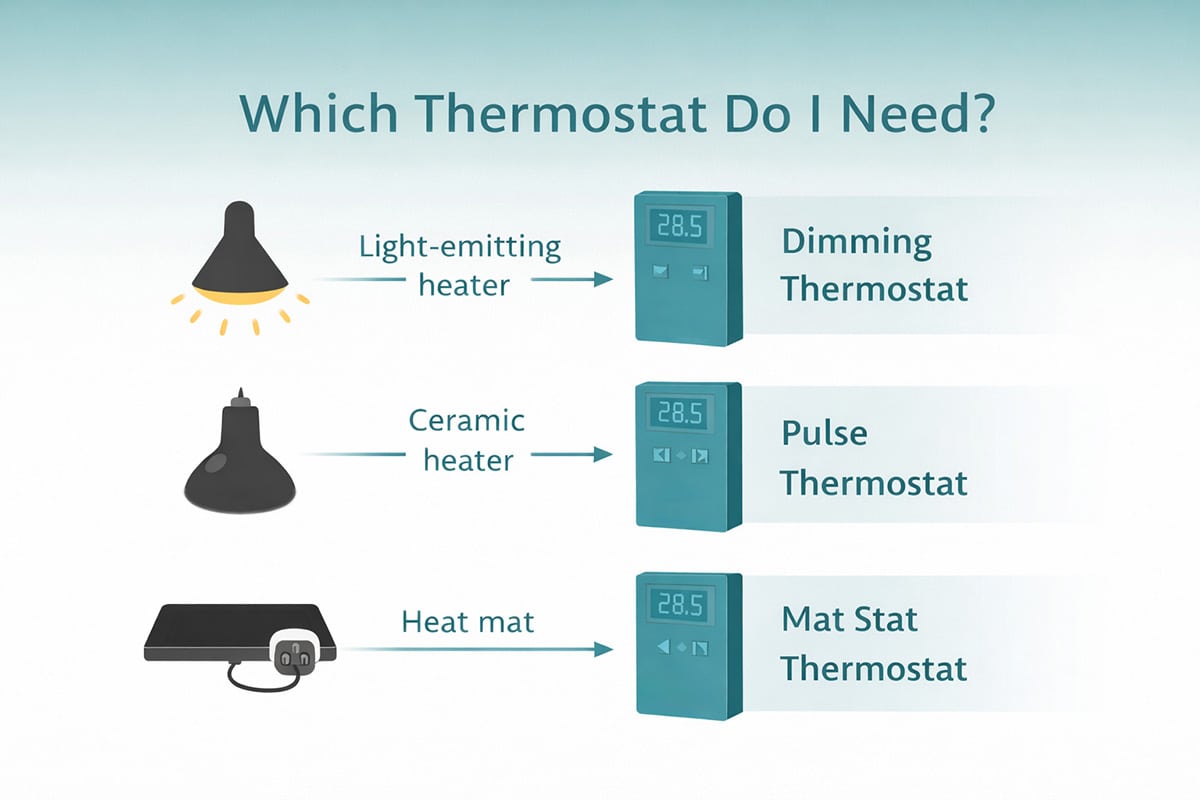
Which Thermostat Do I Need?
Use this quick reference:
- Basking bulbs / halogen lamps / light-emitting heaters → HabiStat Dimming Thermostat Pro
- Day-night temperature cycles + dimming for light-emitting heaters → Digital Dimming Thermostat with Day/Night Timer
- Ceramic heat emitters, heat cable, radiant heat sources → HabiStat Pulse Thermostat Pro
- Heat mats and other low-powered background heaters → HabiStat Mat Stat Thermostat Pro
If you match the thermostat to the heater correctly, you will achieve stable temperatures, a longer heater lifespan, and optimal welfare for your animals.
Thermostat Types Explained
Digital Dimming Thermostat (With Day/Night Timer)
The most advanced thermostat in the range. Perfect for reptile rooms, bioactive setups, and enclosures where you want automated temperature cycles.
- Creates smooth dimming control for basking lamps
- Separate daytime and nighttime temperature programs
- Built-in 24-hour timed circuit for additional equipment
- Continuous readout of temperature, time, and power output
- Waterproof, low-voltage 3m probe
View the Digital Dimming Thermostat →
Dimming Thermostat Pro
The correct thermostat for all light-emitting heat sources. It adjusts power smoothly rather than switching on/off, preventing flicker and maintaining stable basking temperatures.
- Ideal for basking bulbs, incandescent lamps, and halogens
- Delivers smooth, precise dimming control
- Clear LCD readout of temperature
- External fast-blow safety fuse
View the Dimming Thermostat Pro →
Pulse Thermostat Pro
The best choice for ceramic heaters, heat cable, and other non-light-emitting heat sources. Instead of dimming the power, it sends rapid pulses to maintain extremely stable temperatures.
- Specially designed for high-output ceramic heaters
- Provides stable enclosure temperatures with minimal fluctuation
- Not suitable for any light-emitting lamp
- Clear LCD readout and adjustable alarm
View the Pulse Thermostat Pro →
Mat Stat Thermostat Pro
The recommended thermostat for heat mats and low-powered background heating. Uses simple on/off control to maintain consistent mat temperatures without overheating.
- Ideal for geckos, snakes, invertebrates, and small enclosures
- Simple and reliable on/off cycling
- Clear temperature readout with alarm system
- Not suitable for any light-emitting heat source
Thermostat Comparison Table
| Thermostat | Best For | Not For | Max Load | Control Method |
|---|---|---|---|---|
Digital Dimming Thermostat (Day/Night) |
Light-emitting heaters + day/night temperature cycling | — | 600W | Smooth dimming + timed circuits |
Dimming Thermostat Pro |
Basking bulbs, incandescent lamps, halogens | Ceramic heaters | 450W | Smooth dimming |
Pulse Thermostat Pro |
Ceramic heaters, heat cable, high-output radiant heat | Any light-emitting heater | 450W | Rapid pulse proportional control |
Mat Stat Thermostat Pro |
Heat mats and low-power background heaters | Light-emitting heaters | 450W | On/Off control |
Safety & Best Practice
Heat sources can reach extremely high temperatures and must always be installed safely.
- Use only ceramic lamp holders and fittings rated for high heat
- Never run high-temperature heat sources in plastic fittings
- Always use protective lamp guards where there is any risk of contact
- Never operate heat sources without a reliable thermostat
Proper installation protects both the animal and the enclosure from burns, overheating, and fire risk.
Further Reading
Why Calcium Is Important For Reptiles → Understand the role of calcium supplementation and the vitamin D₃ cycle in supporting reptile bone health and long-term wellbeing.
Understanding UVB Lighting for Reptiles → A clear explanation of UVB lighting, intensity levels, and how UVB supports reptile health in captivity.
Understanding Full Spectrum Lighting for Reptiles → Learn how full spectrum lighting supports natural behaviour, activity patterns, and overall wellbeing in reptiles.
The Light and Shade Method → Learn about the importance of providing reptiles with a correct thermal gradient alongside appropriate UVB and full spectrum lighting.
Final Thoughts
Matching your thermostat to your heat source is the key to providing safe and stable temperatures for your reptiles. If in doubt, remember:
- Light = Dimming Thermostat (Digital or Analogue)
- Ceramic = Pulse Thermostat
- Heat Mat = Mat Stat
If you need personalised advice, feel free to contact us — we’re always happy to help.